


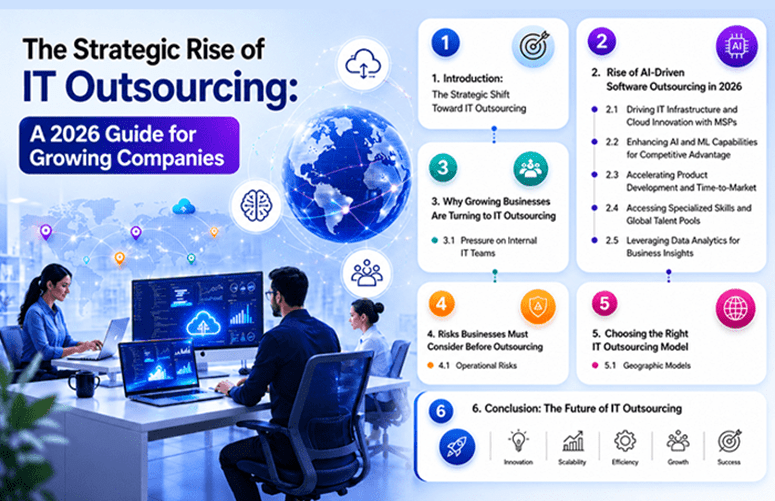
The global business landscape is rapidly evolving, and IT outsourcing is no longer just a cost-saving tactic—it has become a strategic driver of innovation, scalability, and resilience. Companies today are leveraging software outsourcing to access cutting-edge technologies, streamline operations, and stay competitive in an increasingly digital world.
Growing businesses, in particular, are facing mounting pressure due to skill shortages, rising infrastructure complexity, and the need for faster innovation cycles. This is where custom software development outsourcing plays a transformative role in enabling sustainable growth and agility.
👉 For a deeper understanding, explore this In-Depth Software Outsourcing Guide.
2. Rise of AI-Driven Software Outsourcing in 2026
2.1 AI & ML Driving Software Outsourcing Growth
- Increased Demand for AI Expertise:
Businesses are rapidly adopting AI software outsourcing to integrate advanced technologies like machine learning, natural language processing, and predictive analytics into their operations. Building such capabilities internally requires significant investment in time, talent, and infrastructure. By outsourcing, organizations can bypass these barriers and quickly adopt innovation. This shift is a defining factor in software outsourcing trends 2026, where speed and intelligence are critical. - Access to Specialized Talent:
Outsourcing allows companies to collaborate with highly experienced professionals offering AI & ML development services across global markets. These experts bring domain-specific knowledge, proven frameworks, and advanced tools that accelerate development. Instead of struggling with hiring challenges, businesses can leverage ready-to-deploy expertise. This leads to faster innovation cycles and improved product quality.
2.2 Benefits of Custom Software Development Outsourcing
- Faster Decision-Making with Data Insights:
AI-powered solutions provide real-time analytics, enabling businesses to make faster and more accurate decisions. Through custom software development outsourcing, companies can implement intelligent systems that process vast amounts of data efficiently. This eliminates guesswork and enhances strategic planning. As a result, organizations can respond quickly to market changes and customer demands. - Improved Operational Efficiency:
Automation and AI-driven workflows reduce manual processes and operational inefficiencies. By adopting scalable software solutions, companies can streamline operations and optimize resource utilization. This not only improves productivity but also ensures consistent performance across departments. Over time, this leads to more agile and efficient business operations. - Increased Profitability:
Reducing operational costs while improving output quality has a direct impact on profitability. Software outsourcing minimizes expenses related to hiring, training, and infrastructure. At the same time, it enhances delivery speed and product quality. This combination of cost efficiency and performance improvement creates a strong foundation for long-term financial growth.
2.3 Complexity in AI-Based Software Development
- Design & Development Challenges:
Developing AI-based systems requires expertise in data engineering, model training, and system architecture. These complexities make AI software outsourcing a strategic necessity for businesses without specialized teams. External vendors bring structured methodologies and proven approaches to handle such challenges. This ensures efficient development and reduces the risk of failure. - Scalability Requirements:
AI applications must be designed to handle increasing data volumes and user demands over time. Achieving this requires deep expertise in building scalable software solutions with robust infrastructure. Outsourcing partners ensure systems are built with scalability in mind from the start. This prevents performance issues as the business grows. - Integration with Existing Systems:
Integrating new AI solutions with legacy systems is often a complex and delicate process. Custom software development outsourcing helps ensure seamless integration without disrupting current operations. Experienced vendors understand how to align new technologies with existing workflows. This minimizes downtime and ensures a smooth transition.
2.4 Why Outsourcing is the Preferred Approach in 2026
- Cost-Effective Development:
Outsourcing eliminates the need for heavy investments in recruitment, infrastructure, and training. Businesses can access high-quality AI & ML development services at a significantly lower cost. This allows organizations to allocate resources more strategically. Ultimately, it improves financial efficiency while maintaining high standards. - Faster Time-to-Market:
Speed is a critical factor in today’s competitive environment, and software outsourcing enables rapid development and deployment. Experienced vendors follow streamlined processes and agile methodologies. This reduces development cycles and accelerates product launches. Faster time-to-market provides a strong competitive advantage. - Flexibility & Scalability:
Outsourcing offers flexible engagement models that adapt to changing business needs. Companies can scale teams and resources up or down based on project requirements. This level of flexibility is difficult to achieve with in-house teams. Scalable software solutions ensure businesses remain agile in dynamic markets.
2.5 Business Impact of AI Software Outsourcing
- Enhanced Customer Experience:
AI-driven applications enable personalized user experiences and improved customer engagement. Through AI software outsourcing, businesses can deliver smarter and more intuitive digital products. This leads to higher customer satisfaction and retention. Over time, it strengthens brand loyalty and market positioning. - Data-Driven Growth:
Access to real-time insights allows businesses to make informed strategic decisions. Custom software development outsourcing helps organizations unlock the full potential of their data. This drives innovation and supports long-term growth. Companies can identify trends, optimize operations, and improve performance. - Competitive Advantage:
Adopting software outsourcing trends 2026 allows businesses to stay ahead in a rapidly evolving digital landscape. Companies that leverage outsourcing can innovate faster and adapt quickly to changes. This positions them as leaders in their industries. Staying competitive requires continuous evolution, which outsourcing enables.
3. Why Growing Businesses Are Turning to IT Outsourcing
3.1 Pressure on Internal IT Teams
- Skill Gaps in Emerging Technologies:
Many organizations struggle to find skilled professionals in AI, cloud computing, and cybersecurity. This talent shortage makes IT outsourcing a practical solution for accessing expertise. External partners fill these gaps efficiently. This ensures projects are completed without delays or compromises in quality. - Shift from Reactive to Strategic Work:
Internal IT teams often spend most of their time resolving issues rather than driving innovation. This reactive approach limits business growth and slows progress. Software outsourcing allows internal teams to focus on strategic initiatives. This improves overall productivity and innovation capacity.
4. Risks Businesses Must Consider Before Outsourcing
4.1 Operational Risks
- Scope Creep:
When project requirements are not clearly defined, there is a high risk of scope expansion during execution. This can lead to delays, increased costs, and misaligned expectations in IT outsourcing engagements. Businesses must establish detailed project documentation and timelines upfront. Proper planning and continuous monitoring help keep projects on track and within budget. - Unexpected Expenses:
Hidden costs often arise due to unclear pricing models, additional feature requests, or extended timelines. Without transparency, software outsourcing can become more expensive than anticipated. It is important to define cost structures, payment terms, and contingencies in advance. This ensures better financial control and avoids budget overruns.
5. Choosing the Right IT Outsourcing Model
5.1 Geographic Models
- Onshore:
Onshore outsourcing involves working with vendors in the same country, ensuring better communication and regulatory compliance. This model is ideal for projects requiring close collaboration and strict data security. IT outsourcing onshore reduces cultural and language barriers. However, it may come with higher costs compared to other models. - Nearshore:
Nearshore outsourcing offers a balance between cost efficiency and collaboration by working with vendors in nearby countries. Time-zone alignment improves communication and project management. Software outsourcing through nearshore models enables faster response times and better coordination. This makes it a popular choice for growing businesses. - Offshore:
Offshore outsourcing provides access to a global talent pool at significantly lower costs. This model is ideal for large-scale projects requiring specialized expertise. Custom software development outsourcing offshore allows businesses to scale rapidly. However, it requires strong management to handle time-zone and communication challenges.
6. Conclusion: The Future of IT Outsourcing
- Outsourcing as a Digital Transformation Enabler:
The rise of AI software outsourcing and evolving software outsourcing trends 2026 are transforming how businesses operate. Outsourcing enables companies to adopt advanced technologies quickly and efficiently. This accelerates digital transformation and innovation. Businesses that embrace outsourcing are better positioned for future growth. - Building Sustainable Competitive Advantage:
Organizations leveraging custom software development outsourcing can build scalable software solutions that support long-term success. Outsourcing provides flexibility, efficiency, and access to global expertise. This combination helps businesses stay competitive in a rapidly changing market. Strategic outsourcing is key to sustained growth and innovation.